The Claims Problem Most Carriers Are Trying to Fix Too Late
Before carriers automate claims, they need to trust what enters the claim; that is why Trusted Claims Intake AI is becoming the new operating layer for confident claims decisions.
Most carriers do not have a claims problem in the way they think they do. They have an intake problem that keeps showing up later as a claims problem.
That distinction matters because it changes where the work begins. When cycle times stretch, adjusters rework files, fraud signals surface late, severity is missed, documents get lost in attachments, or claims are routed to the wrong handler, the instinct is usually to improve what happens downstream. Add a workflow. Add a review queue. Add a dashboard. Add another automation layer after assignment. Those investments can help, but they often arrive after the most important moment has already passed.
The first moment of a claim determines the quality of everything that follows. If the intake record is incomplete, inconsistent, unstructured, or poorly governed, the rest of the claims organization starts from a deficit. The adjuster begins by cleaning up ambiguity. The triage team makes decisions with partial signals. Supervisors discover severity after the claim has already drifted. SIU sees suspicious patterns after the best intervention window has narrowed. Compliance teams are left asking why a decision was made after the decision is already in motion.
The villain is not legacy claims teams, adjusters, or even old systems. The villain is the worldview of fixing claims problems after bad intake already happened.
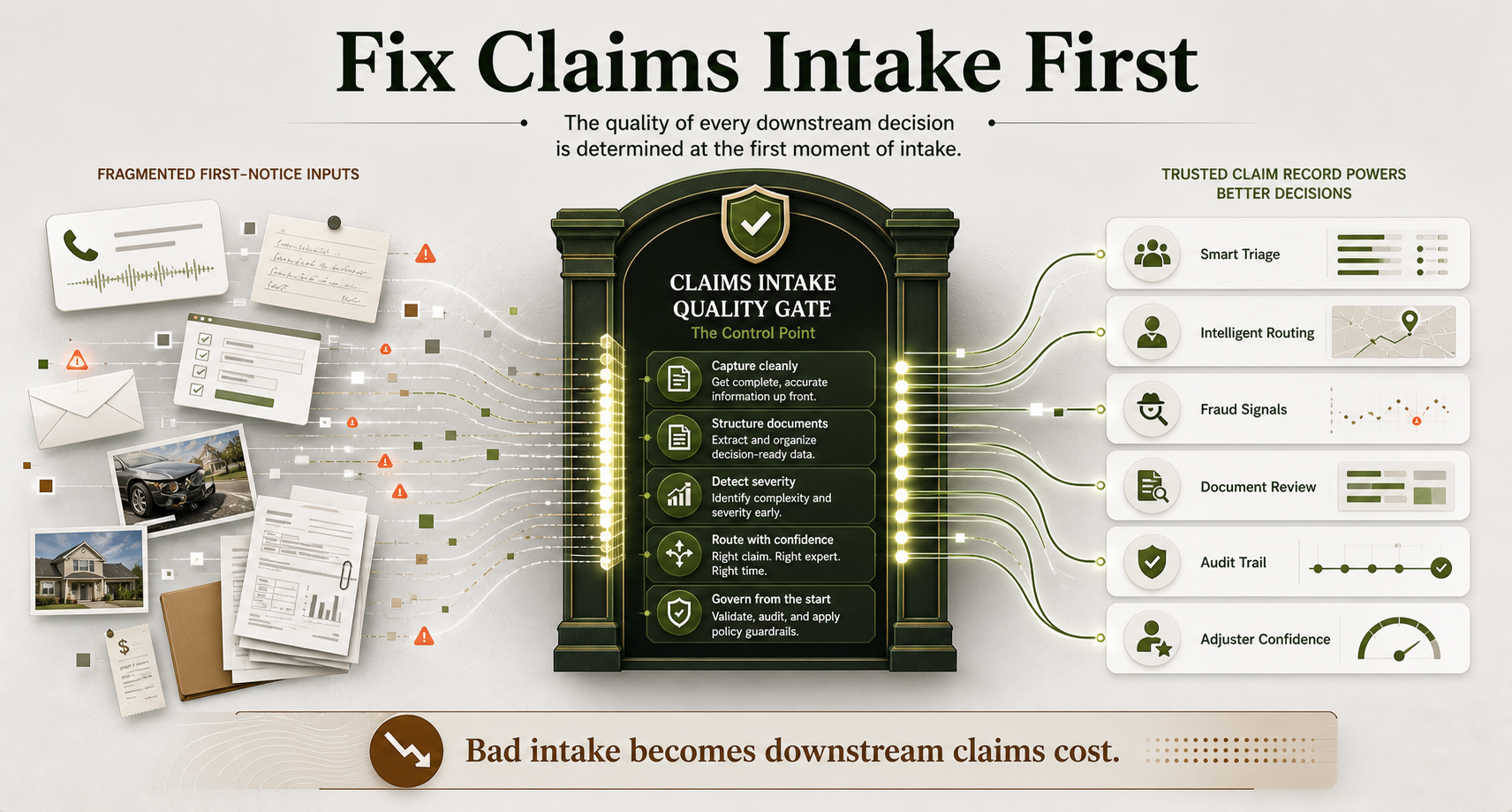
FNOL Is Not a Form. It Is the Control Point.
For too long, first notice of loss has been treated as an administrative step: collect the basics, open the file, assign the claim, and let the downstream process take over. That model made sense when claims systems were mostly systems of record. It makes far less sense in an environment where carriers need earlier severity detection, better fraud signals, smarter routing, stronger governance, and more confident adjuster decisions.
FNOL is not just the beginning of the claim. It is the control point for the entire claim journey.
At intake, the carrier has the chance to understand what happened, what is missing, what conflicts, what documentation exists, what should be requested, what risk signals are present, what coverage context may matter, what level of expertise the claim requires, and what decisions need an audit trail from the start. That is not data entry. That is decision infrastructure.
This is where the category needs sharper language. AI for claims is too broad to be useful. It could mean summarization, chatbots, settlement prediction, litigation analytics, document extraction, or adjuster copilots. Some of those are valuable, but they do not name the leverage point clearly enough.
The better category is Trusted Claims Intake AI: from first notice to confident decision.
Trusted Claims Intake AI starts where claims actually break. It captures information across calls, forms, emails, photos, documents, and other channels. It structures what used to sit in disconnected fields and attachments. It validates what is missing or inconsistent. It surfaces severity, fraud, routing, and compliance signals early. It makes the claim record explainable, reviewable, and governed before downstream work begins.
Triage Is Only as Good as the Record Feeding It
Claims leaders know that triage matters. The right claim needs to reach the right adjuster, unit, specialist, or review path as early as possible. But triage does not become better because an organization names more queues or writes more assignment rules. Triage becomes better when the intake layer produces a trusted claim record.
A simple auto claim and a complex bodily injury claim may look deceptively similar at first notice if the intake process captures only generic fields. A property claim with hidden severity may sit in the wrong path if photos, estimates, weather context, prior loss data, or narrative details are not interpreted together. A suspicious claim may pass as routine if inconsistencies across documents, statements, timing, and parties are not detected early.
The adjuster assignment decision is one of the first economic decisions in the claim. Get it wrong, and the file starts with delay. Get it wrong enough times, and the operation normalizes rework as part of the job.
That is why intake should not simply open the claim. It should prepare the claim for the right decision path.
The best intake layer does not replace adjuster judgment. It protects adjuster judgment from avoidable noise. It gives the adjuster a cleaner starting point, a clearer summary of what is known, an explicit view of what is missing, and a record of why the claim was routed the way it was. The goal is not less human expertise. The goal is to stop wasting expert attention on reconstructing facts the operation should have captured correctly at the beginning.
Governance Cannot Be Bolted On Later
The next generation of claims AI will be judged not only by speed, but by trust. That means governance cannot sit outside the workflow as a policy document or after-the-fact review. It has to be native to the intake process.
Sensitive information needs to be detected and handled appropriately. Decision support needs to be explainable. Routing logic needs to be reviewable. Bias and compliance concerns need to be monitored. Claim facts, document extractions, summaries, confidence signals, and human overrides need to leave a clear audit trail.
This is especially important for mid-market carriers. They need practical AI leverage, but they cannot afford sprawling platform projects, large internal AI teams, or years of experimentation before value appears. They also cannot afford tools that create new governance risk while trying to solve operational friction.
Trusted AI in claims does not mean the system is always right. It means every important decision support action is visible, explained, logged, and reviewable. It means claims leaders can improve operations without turning intake into a black box.
Fix What Enters the Claim
The future of claims transformation starts before the adjuster touches the file.
When Trusted Claims Intake AI wins, the claim record is trusted before assignment. Documents are structured before review. Fraud and severity signals surface early enough to matter. Routing is explainable. Governance is built into the path of work. Adjusters begin with confidence instead of cleanup. Supervisors spend less time managing avoidable exceptions. Leaders can see whether operational friction is coming from staffing, process, severity mix, or intake quality.
That future is not about adding AI everywhere. It is about putting intelligence at the point where every claim begins.
Carriers that keep trying to fix downstream claims problems without fixing intake will continue paying the tax of bad inputs. They may automate pieces of the process, but they will still be automating around uncertainty. The carriers that move earlier will build a different operating model: one where intake is not a form, not a handoff, and not an administrative front door.
Fix claims intake before you fix claims. Everything else gets easier.